


 Cart
Cart


 <% cart_fragment.free_shipping_message %>free shipping


Kesar Benefits: Saffron Uses, Price & Buying Guide

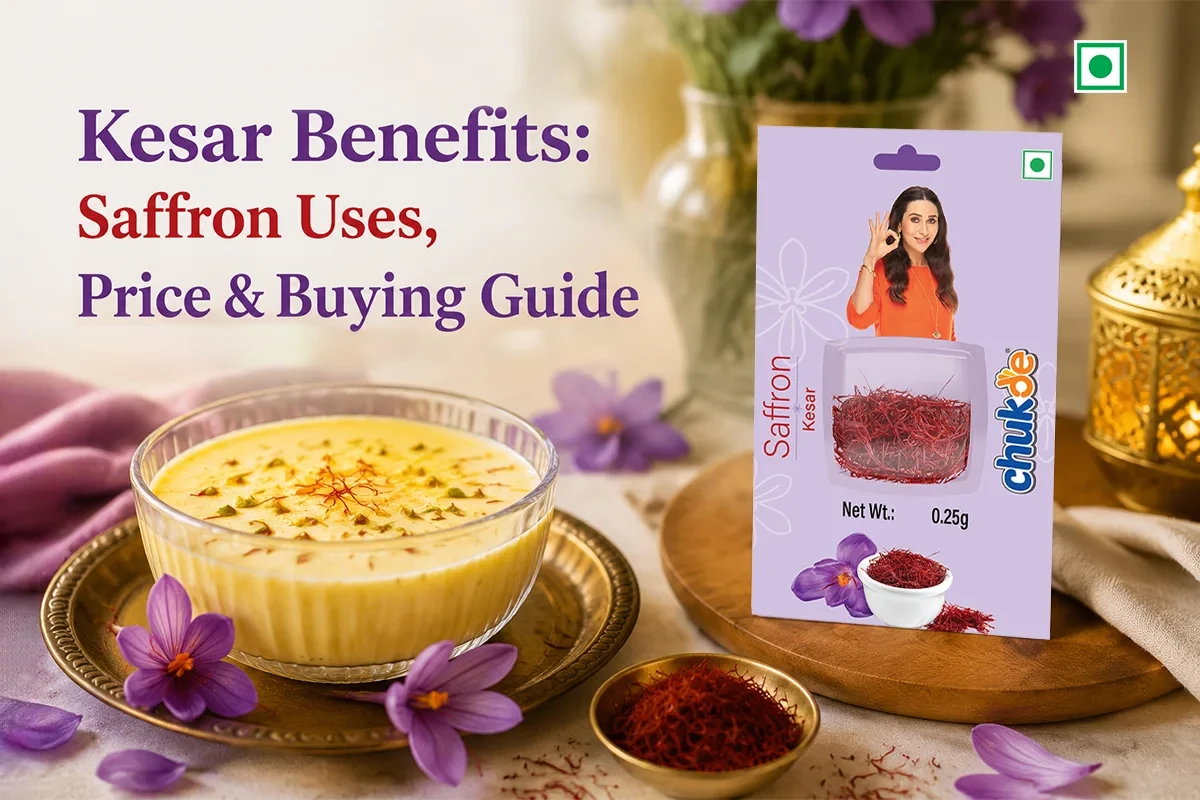
Most Indian kitchens keep a small dabba of orange-red threads for special days. We reach for it when making biryani, kheer, or a glass of warm milk. Yet many home cooks remain unsure about real kesar benefits in food, exact amounts to use, or why the price keeps rising.
This guide covers practical kesar benefits for everyday cooking, the most useful saffron uses in Indian recipes, current 2026 prices with context, and a clear buying approach. You will also get tested strand counts, the correct blooming method, a simple water test, and storage steps that protect aroma so each gram goes further.
What Kesar Actually Is
Kesar is the dried stigma of the Crocus sativus flower. Each flower yields only three thin threads. Farmers pick them by hand during a short autumn window. That limited harvest and careful labour keep the cost high.
In India we call it kesar. The same spice is known as saffron or zafran elsewhere. Kashmir grows most of India’s crop, mainly around Pampore. Iran supplies the bulk of the world market.
From practical kitchen observations, the real value lies in three things: the golden colour it gives milk or rice, the honey-and-hay aroma that lifts a whole dish, and a mild bitterness that stops sweets from tasting flat.
Kesar Benefits in the Kitchen
Kesar supports flavour layering rather than dominating a dish.
It transforms pale rice into rich amber-gold within minutes. When bloomed correctly, it releases a honey-hay warmth that prevents kheer from tasting one-dimensional. The slight bitterness balances rich milk desserts and keeps them from feeling overly sweet.
While testing recipes I have found that 8–12 strands are enough for a family pot of kheer. More than 20 strands in a biryani for four people often turns the taste medicinal. Home cooks also notice that milk infused with kesar feels more fragrant and satisfying. The same threads improve the look and smell of rabri, peda, and sheermal.
These are cooking benefits. Use kesar as a colouring and flavouring agent the way Indian kitchens have done for generations.
Common Saffron Uses in Indian Recipes
Saffron uses fall into three clear groups.
Milk-based dishes
Warm the milk first. Add 4–8 strands and let them sit for 10–15 minutes. The liquid turns golden and carries the aroma into kheer, rasmalai, or simple kesar doodh.
Rice dishes
Bloom the strands in two tablespoons of warm milk or water. Pour the liquid over the rice in the last 10 minutes of cooking. This method works well for biryani, pulao, and zarda.
Sweets and batters
Grind a small pinch with a little sugar or milk. Fold it into cake, barfi, or peda dough. The colour spreads evenly and the flavour stays mild.
How to Bloom Kesar: The Right Method
Never add dry threads straight into hot oil or boiling liquid. High heat burns the volatile oils in seconds and kills the aroma.
- Take the required strands.
- Place them in 2 tablespoons of warm (not boiling) milk or water.
- Let them sit 10–15 minutes until the liquid turns golden.
- Add both the liquid and the threads to the dish near the end of cooking.
This simple step protects the aroma and gives even colour.
How Much Kesar to Use
|
Dish (serves 4) |
Strands |
Best Method |
|
Biryani / Pulao |
12–18 |
Bloom in 2 tbsp warm milk |
|
Kheer / Payasam |
8–12 |
Add near the end |
|
Kesar milk (1 cup) |
4–6 |
Steep 10–15 minutes |
|
Cake or barfi |
Small pinch |
Grind with sugar |
These amounts come from repeated home tests. A 1-gram pack yields 30–40 uses at these home portions.
Current Kesar Price in India (Mid-2026)
Prices have risen sharply. GI-tagged Kashmiri threads commonly sell between ₹350 and ₹400 per gram. Some higher grades cost more. Iranian threads usually sit lower but vary in strength.
One year earlier the same Kashmiri threads often sold between ₹200 and ₹250 per gram. Limited local production and global supply pressure pushed the increase.
A 1-gram pack is normal for careful home use. At proper portions it becomes cost-effective because each use needs only a few strands.
Practical Buying Guide
Focus on three simple checks.
- Thread colour – Look for deep red with a small orange tip. Completely uniform bright red often signals added dye.
- Smell – Good threads smell of honey mixed with dry hay. Strong perfume or no smell at all is a warning.
- Water test – Drop 3–4 strands into warm (not boiling) water. Quality kesar releases a golden-yellow colour slowly over 10–15 minutes. The threads themselves stay red. Instant bright red water usually means dyed material.
When you are ready to buy, choose Kesar Saffron for carefully packed threads suitable for home cooking.
Kesar Water Test Explained
This is the most reliable home check. Place three or four strands in a small glass of warm water. Watch for 10–15 minutes.
Good threads slowly colour the water golden-yellow while remaining red themselves. Threads that turn the water bright red or orange within seconds, or that lose their own colour quickly, are usually dyed or mixed with other plant material.
Buy only the quantity you will use within a year. Store it the same day you bring it home.
Storage Checklist for Better Shelf Life
- Transfer to a small airtight glass or metal jar.
- Keep the jar in a cool, dark cupboard—never near the stove.
- Avoid opening the jar more than necessary. Moisture reduces aroma quickly.
- Write the purchase month on the jar.
Proper airtight storage protects the aroma for 12–18 months.
Common Mistakes to Avoid
Adding dry strands straight into hot oil burns the volatile compounds in seconds. That is why the aroma disappears and the dish gains little flavour.
Using far more strands than needed creates a medicinal bitterness that overpowers the dish. Stick to the tested counts.
Buying large quantities that sit unused for years wastes money. Threads lose strength over time even when stored well.
Storing in clear plastic bags on an open shelf exposes the threads to light and moisture. Both destroy aroma faster than heat alone.
Conclusion
Kesar benefits show clearly in the kitchen through better colour, deeper aroma, and balanced flavour in rice, milk, and sweets. Saffron uses stay simple once you learn to bloom the threads first. Current prices sit higher than last year, so buy only what you need and store it carefully.
A few well-handled strands transform ordinary dishes. Explore Kesar Saffron and other whole spices that pair well with kesar, try the blooming method in your next kheer, and notice the difference. Small changes in how you use this spice make a clear improvement in home cooking.
Frequently Asked Questions
What are the main kesar benefits in cooking?
Kesar gives natural golden colour, a honey-hay aroma, and mild bitterness that balances sweets and rice dishes.
How much kesar should I use in biryani?
12–18 strands bloomed in warm milk are enough for a family-sized biryani.
What is the current kesar price in India?
As of mid-2026, good Kashmiri threads commonly sell between ₹350 and ₹400 per gram.
How do I check kesar quality at home?
Drop strands in warm water. Quality kesar slowly turns the water golden-yellow while the threads stay red.
How should I store kesar?
Keep it in a small airtight container in a cool, dark place away from moisture and heat.
References & Further Reading
For food labelling and quality standards in India, refer to the Food Safety and Standards Authority of India (FSSAI).
Nutritional composition data for spices can be cross-checked at USDA FoodData Central.
Related articles
Learn kesar benefits, kitchen uses, bloom method, food amounts, and home tests to spot quality saffron threads.
Make soft, delicious no-cook coconut modaks in just 10 minutes using simple ingredients. An easy festive sweet perfect for Ganesh Chaturthi celebrations.

Make soft, flavourful Besan Mawa Modak for Ganesh Chaturthi with an easy step-by-step recipe, perfect for bhog, prasad and festive celebrations at home.
Flax seeds are back in Indian kitchens. See why demand is rising, useful food points, roast-and-grind steps, storage tips and easy daily uses.
<% quickViewcurrVar.entity.title %> (<% quickViewcurrVar.price.off %>)
<% formatCurr(quickViewcurrVar.price.regular, quickViewcurrVar.price.curr_info) %> <% formatCurr(quickViewcurrVar.price.sale, quickViewcurrVar.price.curr_info) %> (Inc. tax) (Ex. tax)
Description (SKU - <% quickViewcurrVar.sku %>)
 TBS points:
 Tags & Categories:

Powered by Science

100% cruelty free

Made in India
 100% safe
checkout
100% safe
checkout

Invalid Product!


Checkout in
& get 2% OFF